Andrew Bakiza has made his opening move, and it is anything but cautious.
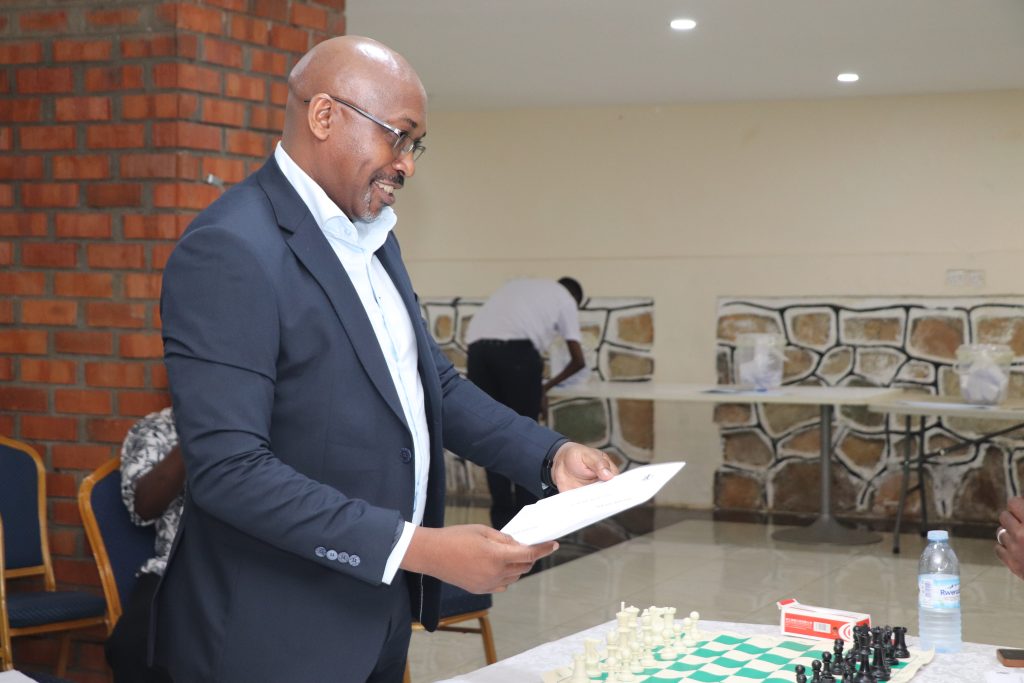
The 50-year-old engineer, with a career spanning telecom giants, government projects, and corporate reform, is the new president of the Uganda Chess Federation.
This was reaffirmed at the swearing ceremony held at Kati Kati Restaurant last Friday 19th December 2025, along side his Excom Committee.
His pitch is clear and confident, almost like a well-rehearsed gambit: “strong management, strong funding, strong players.”
Bakiza’s résumé reads more like a boardroom profile than a sports dossier.
He has worked with MTN Uganda, Airtel, Liquid Telecom, and Zain, contributed to government digitization under a World Bank project, and chaired the Ease of Doing Business Committee under the Presidential CEO’s Forum for eight years.
Now, he says, it is time to apply corporate discipline to an intellectual sport he believes has been under-managed for too long.
“At its core, chess is an intellectual sport,” Bakiza said. “I have been in rooms where players were architects, lawyers, engineers, many with Master’s degrees. These are people with serious potential who just need structure, welfare, and opportunity.”
Cooling Tempers, Tightening Systems
Bakiza takes office at a delicate moment. The federation has faced internal friction and is still working toward full certification from the National Council of Sports (NCS). His approach is calm and procedural.
“I believe in reconciliation, but guided by rules,” he said. “As president, I represent everyone. No grudges. Strong management means transparency, discipline, and accountability for all.”
A key early target is upgrading chess from a Tier 4 to a Tier 3 federation under the new Sports Act, a move that would unlock better government funding. The catch? Grassroots reach.
Chess Beyond the City
Bakiza plans to decentralize chess administration by strengthening regional associations in Western, Northern, Eastern, and Central Uganda. These structures, he says, exist but are weak.
His plan is to equip them with boards and clocks, fund them proportionally, and demand clear district-level plans with proper reporting.
“Chess has been too centralized,” he noted. “Yet talent is everywhere, including in the informal sector. We must reach the last mile.”
Schools are central to this expansion.
Bakiza is courting corporate partners to sponsor school chess programs, revealing talks with banks such as Centenary and Citibank.
The message is simple: good management attracts support.
Bigger Rewards, Bigger Vision
Bakiza is also raising expectations for players. He has pledged to increase international prize money fivefold and has floated an ambitious idea of awarding a car annually to the country’s best player.
He wants chess to be more visible too. Digital boards connected to the internet, he says, can turn tournaments into spectator events, much like football. His long-term dream includes deploying up to 1,000 digital boards nationwide.
And perhaps his boldest promise: by July next year, Ugandan chess will have a permanent home, not borrowed hotel rooms.
“I am ready to be held accountable,” Bakiza said.
He won the presidency in a three-way race by 14 votes, succeeding Mwaka Emmanuel.
For Uganda’s chess community, the game is now underway. Whether Bakiza’s corporate gambit ends in checkmate or stalemate will be revealed before 2026.
Can Bakiza checkmate; old problems in Ugandan Chess?
By Executive Editor
December 20, 2025
194
0